
Tereza Kalousova

Tereza Kalousova is a Czech-based artist working across film and architecture.
Can you introduce yourself and your practice?
I’m an artist and architect. Most of my work examines how processes of virtualisation and of neoliberal infrastructures and its latent systems reconfigure our sense of bodily presence, time, and space. I’m drawn to moments of suspension: when forms and systems can neither continue nor collapse. I examine what happens in such states with care, intimacy and proximity: the body failing as interface, how closeness warps, and language falters. I’m interested in how we navigate that space through dissociation, endurance, and repetition - what persists and what then still constitutes humanness.
What question sits at the centre of your work right now?
Currently, my central question concerns exhaustion, I would say, as both a structural condition and a situational state. In a recent work, an exhibition I did together with Šimon Chlouba, we explored the collapse of productivity through different scales: the idling software process, labour burnout, the suspended body, or personal paralysis, seeing how those states might overlap. I am interested in the threshold at which agency collapses and attention reconfigures into this other temporality that appears when systems, software, or selves fall into idle. Something quieter, partially unbearable, but attentive. A form of sensitivity that, for that very moment, resists acceleration.
Loneliness and “disorientation” recur in your work, particularly in relation to the city, acceleration, and virtual/real boundaries. What personal or theoretical moments helped you anchor these as ongoing concerns?
I feel like I inhabit a somewhat permanent overstimulation, where perception is intense but ungrounded. Maybe it’s partially because of my ADHD. I think the overstimulation also links to a slight continuous detachment from really being in my body unless it is the main and only thing I am giving focus to - which, in a way, parallels the real/virtual modes of being. Reading critical and architecture theory (from David Harvey to Silvia Federici, Mark Fisher, Sara Ahmed, or Byung-Chul Han, Žižek,..) gave me tools to understand that the experiencing isn’t just personal - it’s systemic, designed into our environments and technologies.
I think there’s generally not so much choice in what the underlying intensities in one’s work are. Even as I choose to address different topics, there is a recurring tension that leads back to the personal - and I think that’s kind of necessary; a personal urgency that is strong enough to transmit, and to carry informational layers with it.
There is also an ongoing focus on liminality and alienation in your work. Do you see this as personally influenced by your upbringing or by living in a variety of different cultures and contexts?
There probably is some influence: each of my immediate family members lives in a different country, growing up I didn’t really have a sense of a place as home. But I also think those experiences are symptomatic of the contemporary world: having none or multiple home-places, layered identities, and fluid attachments, which can deprive you of the traditional cornerstones of identity-building, some fixed points of reference, but also allow you to construct it differently. Although I do work from a personal position, which I always try to be conscious of, I don’t like to represent it, more so use it as a sensorial or perceptual tool to interrogate larger structures and dynamics.
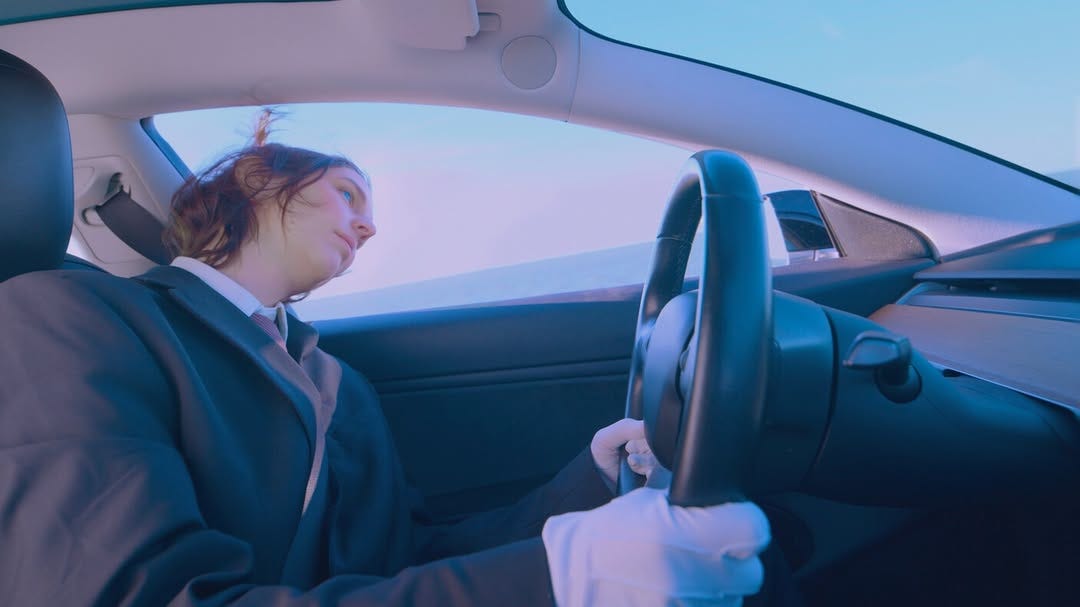
In your recent solo show To The Bone, you explore the car as an exoskeleton that embodies protection, freedom, power, and control. What drew you to the car as metaphor, and what does it allow you to explore about identity and vulnerability?
I was drawn to the car as something that symbolises technocratic sleekness, which somehow brings with it this promise of coherence. Sleekness is seductive, whether it’s a vehicle or a digital interface, it performs control, frictionless efficiency, the fantasy of a self fully contained. It erases its own embodiment, its porousness, its limits, which then translates to the user-driver, and instead creates an illusion of the absolute and sustained.
In a state of instability or fragmentation, that fantasy can feel like a form of salvation, something that momentarily organises chaos into coherence and into a smooth flow of information.
In To The Bone, I tried to enter through that aesthetic to explore what it lacks. The protagonist- driver isn’t portrayed as powerful or autonomous (as would be in a motocratic, totalitarian narrative) but vulnerable and permeable inside a structure that further isolates them. Their transformation isn’t heroic but intimate and strange. I’m interested in that tension between critique and desire: knowing what is false, yet still needing it. For me, there is always a small hesitation - what if what it offers is actually the closest to contentment that one can achieve, being already a changed entity?
Are there any particular influences that have shaped your work? Could be an artist, designer, writer, a specific project, or something entirely different.
I thought of two specific events that have shaped my practice at the very beginning of it. First being Ed Atkins’ lecture and screening in 2018 - I went there without knowing his work prior, and I was really touched. His work was shamelessly affective and atmospheric as much as formal and technically impressive, while also subversively political. At once personal and depersonalised, so sad and lonely but also hopeful in the way of being so successful at communicating it. Second, studying a semester in Sam Lewitt’s studio, where I made my first video. He had, what seemed to me, a firm system of what art is and what it can do - for him and the world - which, through a merging of rational and intuitive reasoning, transferred a very dedicated trust in art to me.
There are so many artists, writers, and projects that continuously shape my work though, very often my friends.
Cinematography is a core component of your work. Are there any specific filmmakers who have influenced you?
In no consecutive order: Marianna Simnett, Rachel Maclean, again - Ed Atkins, Martins Kohout (Slides, 2018), Ericka Beckman, Philip Ullman, Ayoung Kim, Lawrence Lek, Wong Kar-wai and more.
To me, these filmmakers use image and sound as something embodied. They also work with emotion as something mediated, through artifice, technology, or exaggerated stylisation (or Wong Kar-wai through absence and space), as if it is something that is not accessible directly. I like how they explore how we inhabit spaces - real, digital, or psychological, that are simultaneously thoroughly constructed and uncannily unstable.
What are you interested in outside of art/design right now?
The ongoing genocide in Gaza, the rise of the far right, and, with that, currently also the Czech political post-election situation. On a very different scale, I am interested in my community, my puppy Vegas, urban sociology, reality TV and interpersonal relationships, and my football team Random Radical.
How do you support your practice? And, if appropriate, have you faced any particular challenges in realising a project or sustaining your practice more generally?
So far, I’ve been a student, so artistic funding wasn’t so accessible. Even though my recent works have been supported by institutions, it has just about (or not even) covered production costs. So I have sustained it by working jobs mostly vaguely or non-related to my practice. I’ve gone through quite a few - food delivery, tour guide, art handler, hospitality worker, shoe shop seller, architect. Currently, I am trying out a new strategy - working 50-hour weeks as a film set designer - for a limited period, which will allow me to go for months afterward without working. But it also means that now I am doing artistic night shifts. So the challenge for me is exhaustion and time.
Are there any upcoming plans or projects you can share?
I’ve written a new script for a video - it involves a dog, lactation, and a late-night show - and I’m currently applying for funding to produce it. I’m also preparing a performance with my friend and artist Nelli Molfenter (Nemo), which will be part of a show in Prague this November that I’ve had the chance to organise. Since I’m hopefully graduating from the Dirty Art Department this year, I want to use the next six months to focus mainly on one project - maybe the video.
Do you have any recommendations for an early-stage artist?
I think something that is important for me is to have an internal system of why you are doing what you are, why it matters - and staying in touch with it as it shifts over time. It allows you to take risks, accept critique, and navigate external pressures without them necessarily being threatening to your practice or your motivation to sustain it. Also, take ideological and emotional care of your practice, to protect its joy. For me, that means having enough time to develop the work, to allow it to change during the process, so it can bring something new back. Time, of course, is a tricky thing and a privilege.